Common Tactical Picture
Multi-source operational awareness, mission planning and decision support. One governed subscriber of the layer below.
- 3D / 2D picture
- mission planning
- provenance
- governed actions
Mission data platform
Fugentix is the semantic foundation between your sensors, command systems and partners. It learns what every field means, enforces who may see it, and delivers one governed picture. Configured, not coded.

Profile-driven decoders for the formats you already run
01 The problem
Every system holds one piece of the picture, in its own format, with its own identifiers. Wire twelve of them together directly and you maintain one hundred and thirty-two interfaces. Each one is built, secured and kept in sync by hand.
02 The platform
Fugentix sits between the systems you have and the people who decide. Each layer does one job, and the data stays with its owners.
Multi-source operational awareness, mission planning and decision support. One governed subscriber of the layer below.
Federated semantic data services. Every record passes a contract, a signed translation and a policy check before it is delivered.
The semantic foundation: what every field means and how sensitive it is, computed from metadata alone.
03 Capabilities
Six steps, one governed record. These are screens from the running product.
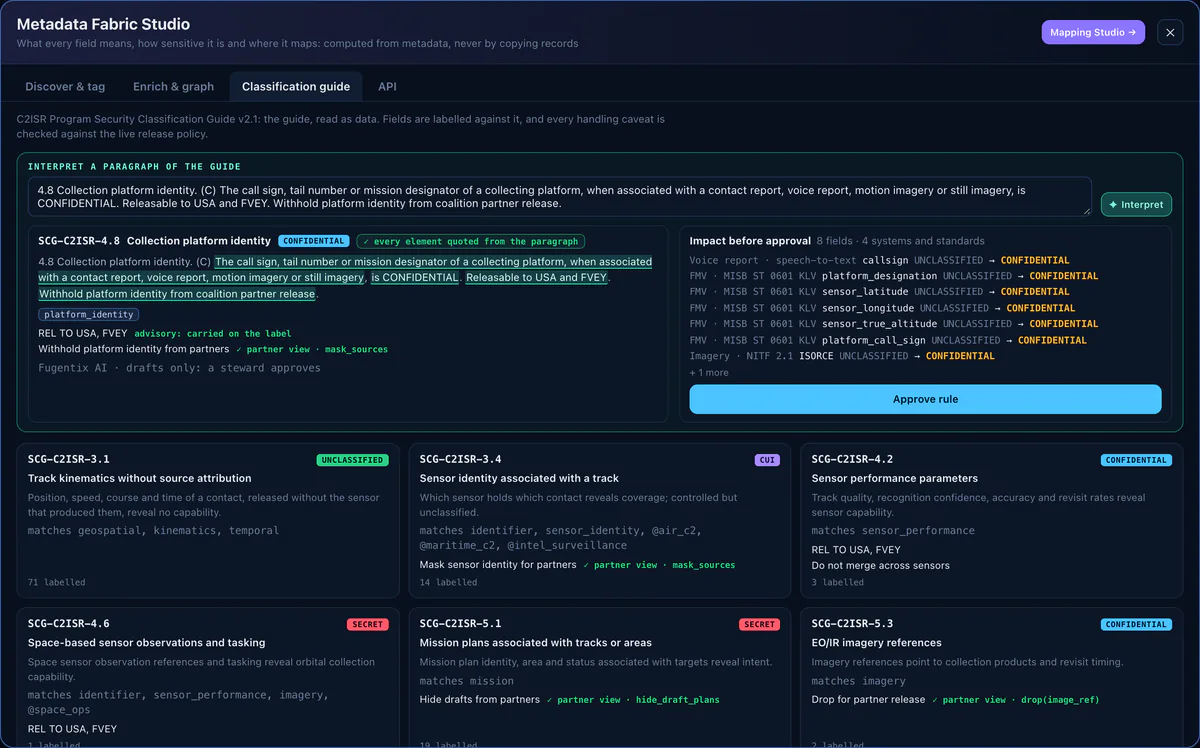
Metadata Fabric discovers your systems, exchange standards and fields, and tags each one with its meaning and the mission it serves.
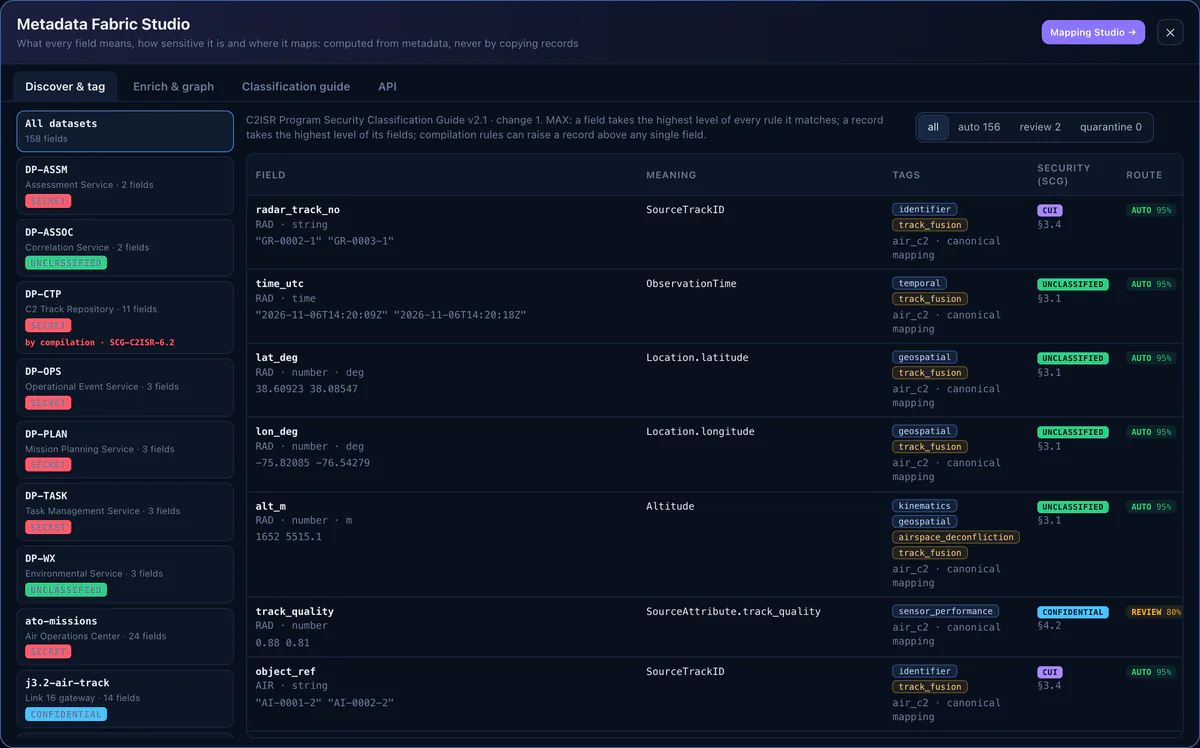
The guide is read as data. New guidance arrives as a paragraph, becomes a rule a steward can approve, and is enforced where the data leaves.
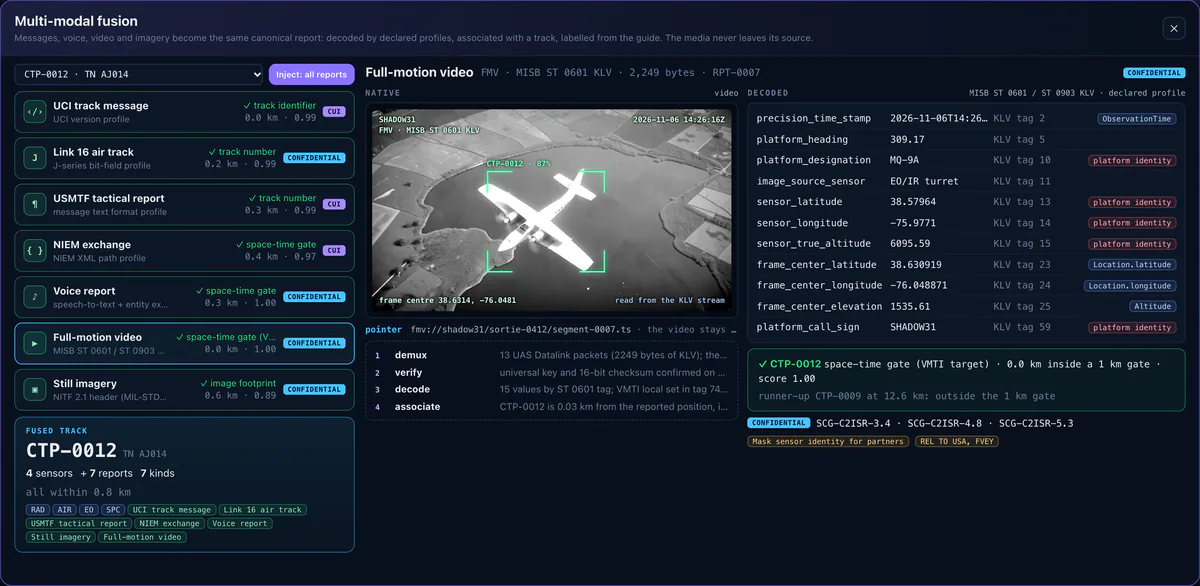
Seven kinds of report become the same canonical observation and are tied to one track, each traceable to its source.
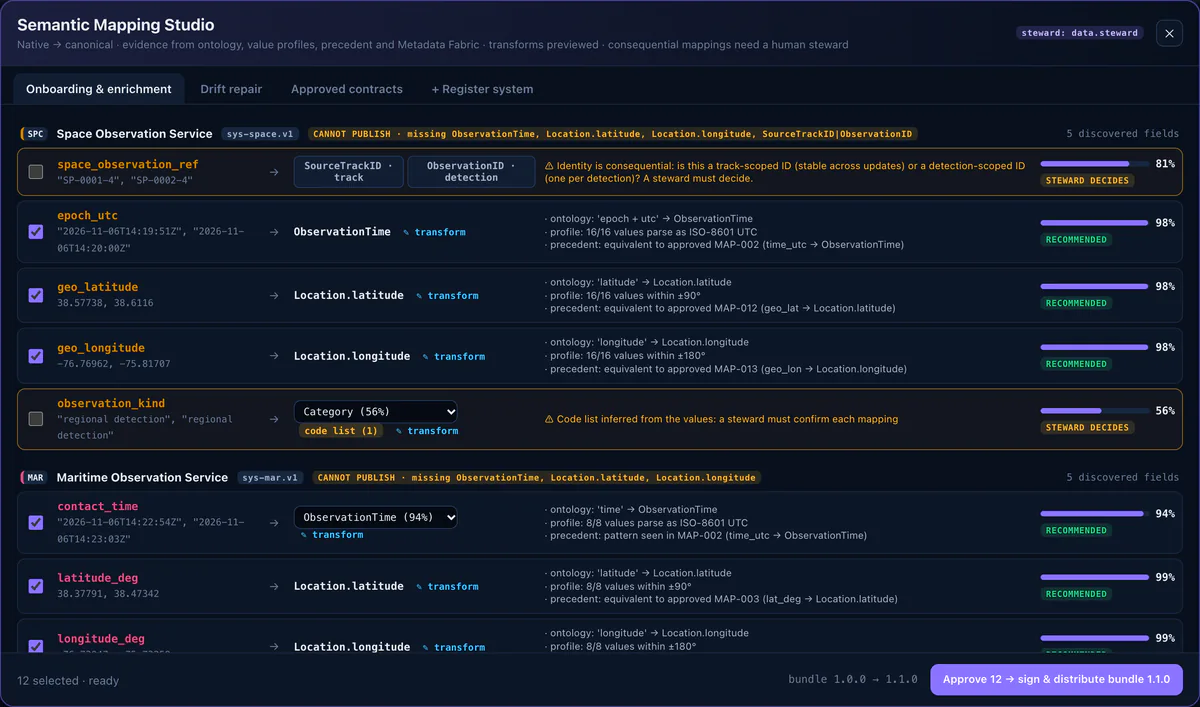
The fabric proposes each mapping from evidence. People decide the ambiguous ones, and one approval puts the source in front of every consumer.
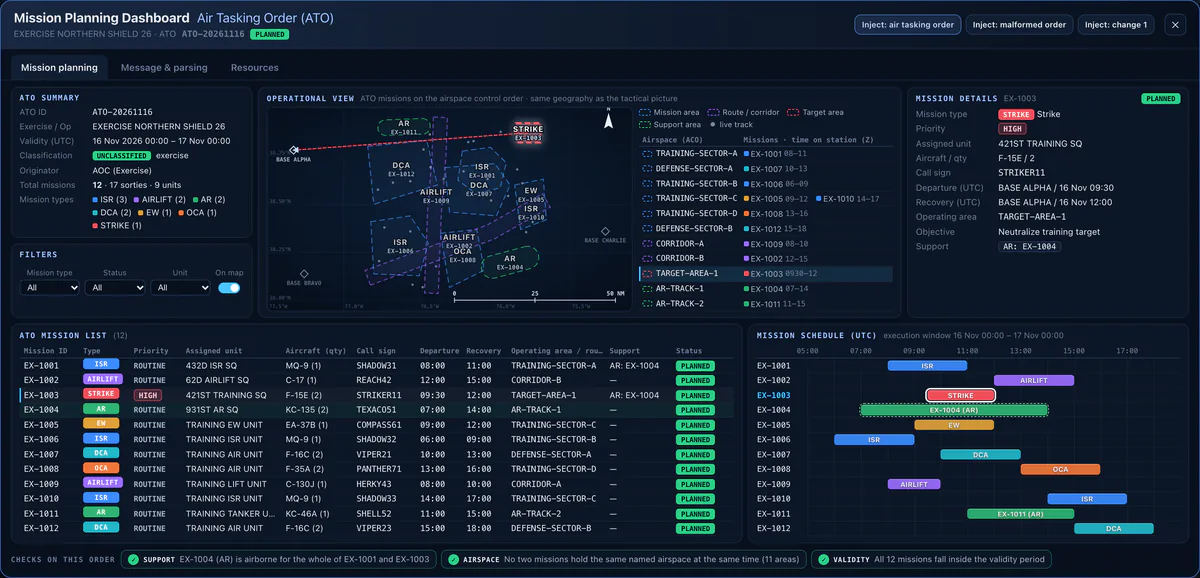
Tasking orders are parsed deterministically and shown as one plan: airspace, missions and schedule, in the same geography as the live picture.
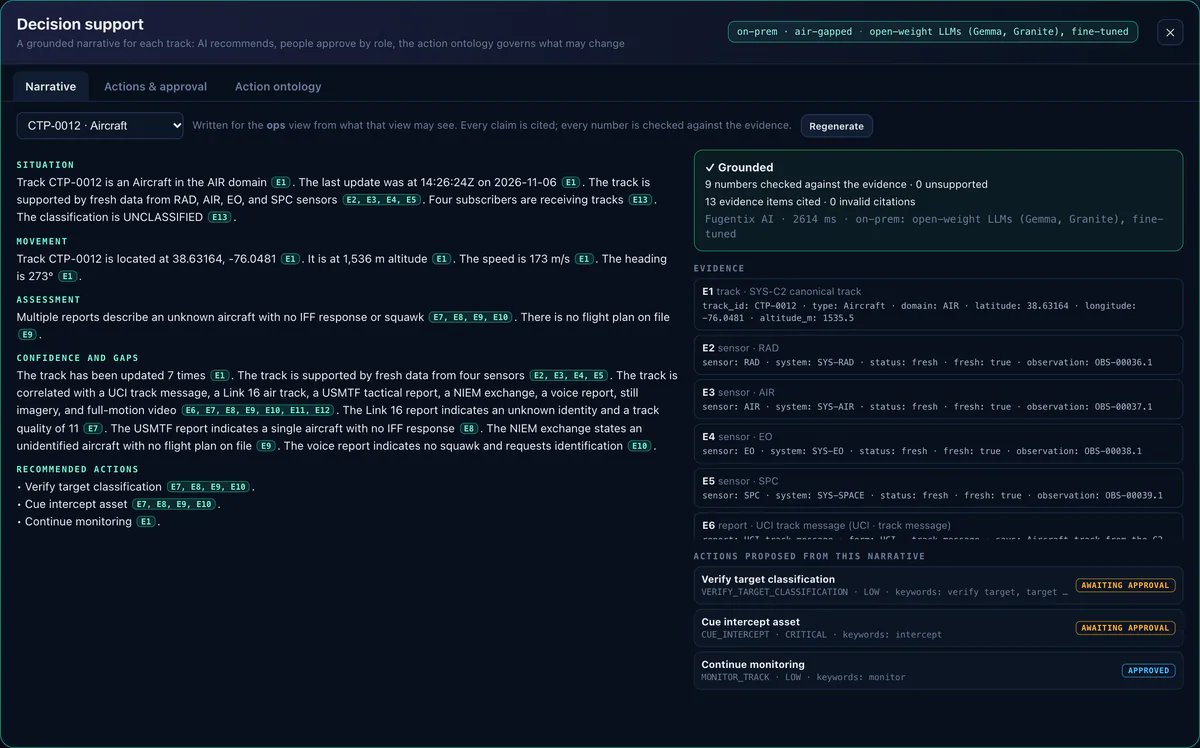
AI writes the situation narrative from what each viewer may see. Its recommendations become actions only through people.
04 Trust
Contract gate
When a source changes format without notice, the gate holds its data instead of breaking every consumer. The repair is proven on the held records, approved by a person, and the records are replayed in order.
Provenance
Each field leads to its source message, the mapping that translated it and the policy that released it.
Interoperability
Synchronises with partner ontologies in both directions. Field ownership is enforced, echoes are suppressed, and versions of a standard reconcile into one record.
AI
AI drafts and recommends; people approve. Outputs are grounded in cited evidence, and every AI-assisted feature has a rule-based path when no model is available.
Governance
Mapping bundles are signed and versioned. Policy is enforced at the edge for each viewer, and every decision, approval and release is written to the audit trail.
05 Deployment
The whole stack runs inside your enclave. Nothing leaves it.
Language models such as Gemma or Granite are served locally and can be tuned for your mission. Embeddings run offline.
PostgreSQL, Kafka, OIDC sign-on and Prometheus metrics: components your teams already operate.
The fabric works from metadata and pointers. Source systems keep their records.
Fugentix
See the platform on your own scenario: a working session with the people who build it.